
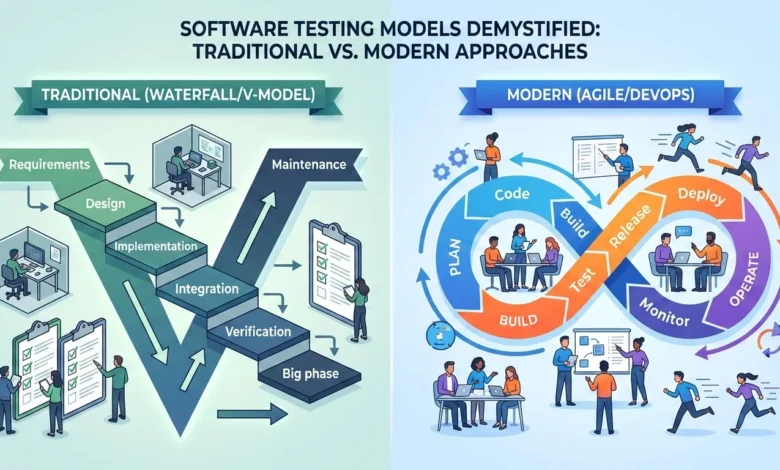
Software testing models define how testing activities are structured within the software development lifecycle. These models determine when testing begins, how it progresses, and how it aligns with development phases. Selecting appropriate software testing models is essential for maintaining quality, controlling risks, and ensuring predictable delivery timelines. In 2026, organizations increasingly align their models with automation frameworks, CI/CD pipelines, and business agility goals.
Software testing models differ from testing techniques. While techniques focus on specific methods such as unit testing or regression testing provide a process-level framework that integrates testing into development activities.
Table of contents
Waterfall Testing Model
The Waterfall model is one of the earliest software testing models and follows a linear, sequential structure. Each development phase must be completed before the next begins, and testing starts only after development is finished.
This model emphasizes documentation, requirement stability, and formal approvals. However, defect detection occurs late in the lifecycle, which increases the cost of changes. Waterfall-based software testing models are best suited for small projects with fixed requirements and limited scope changes.
V-Model (Verification and Validation Model)
The V-Model extends the Waterfall approach by mapping each development phase to a corresponding testing phase. Test planning begins early, during requirement and design stages.
Among structured the V-Model offers strong traceability between requirements and test cases. It is widely used in regulated industries such as healthcare, banking, and aerospace where validation and compliance are mandatory.
Agile Testing Model
The Agile model integrates testing continuously within short development iterations known as sprints. Testing teams collaborate closely with developers, enabling rapid feedback and quick defect resolution.
Agile-based software testing models prioritize adaptability, customer involvement, and incremental delivery. In 2026, Agile remains one of the most widely adopted because it supports evolving requirements and faster release cycles.
Spiral Testing Model
The Spiral model combines iterative development with structured risk analysis. Each iteration focuses on identifying, evaluating, and mitigating risks before moving forward.
Among various Spiral is particularly effective for large-scale, high-risk, or mission-critical systems. It provides flexibility while maintaining strong risk management practices.
Dev Ops Testing Model
The DevOps testing model integrates automated testing into continuous integration and continuous deployment pipelines. Testing occurs throughout the lifecycle and is heavily automated.
Modern software increasingly incorporate Dev Ops principles to enable rapid releases without compromising quality. Cloud-based testing environments, automated regression suites, and performance monitoring tools are core components of this model.
Comparison of Software Testing Models
Different software testing models vary in flexibility, documentation requirements, risk management capability, and speed of delivery. Traditional models like Waterfall and V-Model emphasize structured processes and documentation. Agile and DevOps models focus on flexibility and rapid iteration. Spiral provides advanced risk management but may require higher expertise and budget.
Selecting the right requires evaluating project size, requirement stability, regulatory constraints, and organizational maturity.
Also Read: Matthew Heusser Software Testing Strategies – Complete Book Guide
Advantages of Using Structured Software Testing Models
Structured software testing models provide a disciplined framework for managing quality assurance activities. By clearly defining testing phases, responsibilities, and deliverables, these models reduce ambiguity and improve coordination between development and QA teams. They enable early defect detection, better requirement traceability, and improved risk mitigation.
Organizations that implement well-defined software testing models often experience fewer production failures, lower maintenance costs, and higher stakeholder confidence. Additionally, structured models enhance documentation quality, which is especially critical in regulated industries and large enterprise environments.
Challenges in Implementing Software Testing Models
Despite their benefits, software testing models can present implementation challenges. Rigid models such as Waterfall may struggle to accommodate changing requirements, while modern Agile and DevOps models require strong automation maturity and cultural alignment. Poorly defined processes, lack of skilled testers, and insufficient tool integration can weaken the effectiveness of software testing models. To overcome these challenges, organizations must invest in training, adopt appropriate testing tools, and continuously refine their testing strategy to align with evolving business and technological demands.
Trends in Software Testing Models in 2026
In 2026, software testing models are evolving to include AI-assisted automation, shift-left and shift-right testing strategies, security integration (DevSecOps), and real-time quality monitoring. Rather than eliminating traditional frameworks, modern organizations adapt to align with digital transformation goals and cloud-native architectures.
Conclusion
Software testing models serve as the structural foundation of quality assurance. A well-defined model ensures systematic defect detection, better stakeholder communication, improved predictability, and reduced production failures. By selecting appropriate software testing models based on project requirements and organizational capabilities, teams can deliver reliable, high-quality software in competitive environments.
FAQ
What are software testing models?
They are structured frameworks that define how testing activities are integrated into the software development lifecycle. They determine when testing begins, how it progresses, and how it aligns with development phases to ensure systematic quality assurance.
Why are software testing models important?
This important because they provide a clear roadmap for testing activities. They improve defect detection timing, reduce project risks, enhance team coordination, and ensure better product quality before deployment.
What is the difference between software testing models and testing techniques?
It focus on the overall process structure and lifecycle alignment of testing. Testing techniques, on the other hand, define specific methods used to identify defects, such as black-box testing, white-box testing, or regression testing.
Which software testing model is best for Agile projects?
For Agile projects, the Agile testing model or DevOps-based testing model is most suitable. These support continuous integration, rapid feedback, automation, and frequent releases.
Are traditional software testing models still relevant in 2026?
Yes, traditional Waterfall and V-Model are still relevant, especially in industries that require strict documentation, compliance, and regulatory validation. However, many organizations combine traditional and modern approaches.