Here is something most people never think about. Every time you scan a product at a checkout counter, every time a warehouse worker logs incoming stock, every time a consumer app pulls up product details from a camera scan — there is a lookup happening in the background. A barcode number flies into a database, and structured product data flies back out. Billions of these exchanges happen every day across global commerce. BarcodeReport is one of the platforms making that exchange possible, and it does so with a focus on UPC and EAN barcode data that few competitors can match.
This article is a thorough, practical look at BarcodeReport — what it offers, who uses it, how its barcode lookup technology works across global markets, and why developers building barcode scanning applications consistently reach for it when they need reliable product data at scale. If you have ever wondered what sits behind the barcode on a product you bought, this is where that answer starts.
Table of contents
- BarcodeReport at a Glance: A Barcode Lookup Service With Genuine Depth
- UPC and EAN: The Global Barcode Standards BarcodeReport Is Built Around
- The BarcodeReport Database: How Vast Coverage Gets Built and Maintained
- BarcodeReport Feature Comparison: How It Stacks Up Against Alternatives
- Developer Integration: Building Barcode Scanning Apps With BarcodeReport
- How Real Businesses Apply BarcodeReport Every Day?
- Gaming and Consumer Technology: Unexpected Places BarcodeReport Shows Up
- Global Users: BarcodeReport Across International Markets
- Conclusion
BarcodeReport at a Glance: A Barcode Lookup Service With Genuine Depth
BarcodeReport is not a general product search engine with barcode support tacked on. It was built specifically around UPC and EAN barcode lookup — the two dominant barcode formats in global consumer commerce. UPC codes, those 12-digit identifiers printed on North American products, and EAN codes, the 13-digit international equivalents used across Europe, Asia, and Latin America, form the backbone of the platform’s database. That focus matters. Platforms that treat barcode lookup as one feature among many tend to deliver shallower coverage and less reliable data than platforms where barcode lookup is the entire point.
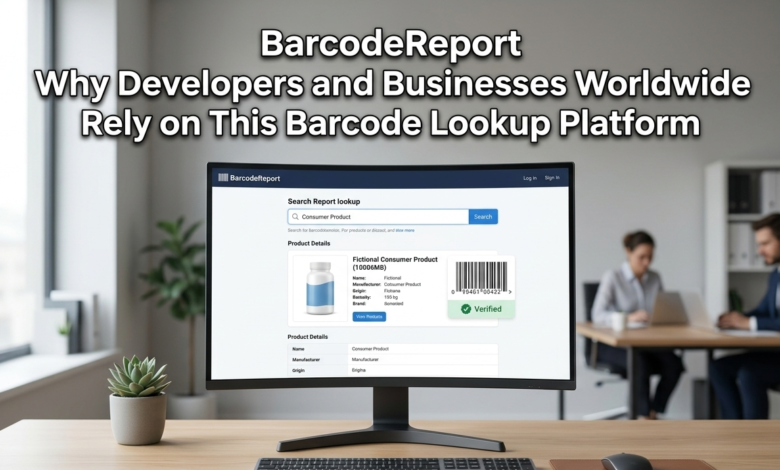
What BarcodeReport returns for any given UPC or EAN scan goes considerably beyond a product name. The platform surfaces brand and manufacturer details, product category classification, physical descriptions, imagery, and in many cases pricing pulled from multiple retail sources simultaneously. For a developer building a barcode scanning app or a business automating its product data workflow, that depth of output is the difference between a useful tool and a transformative one.
UPC and EAN: The Global Barcode Standards BarcodeReport Is Built Around
Understanding why UPC and EAN coverage matters requires a brief look at how these standards actually work in practice. Developers created the Universal Product Code in the 1970s for North American grocery retail, and it quickly expanded across all consumer product categories. It is a 12-digit numeric code that uniquely identifies a specific product from a specific manufacturer at a specific package size. The European Article Number extended this system internationally by adding a 13th digit representing a country or region prefix, while remaining backward compatible with UPC infrastructure.
Today, GS1 administers both formats under its global standards framework, allowing products made in Germany with an EAN code to sell in the United States, where UPC dominates, while barcode lookup systems seamlessly translate between the formats. BarcodeReport’s deliberate investment in both UPC and EAN coverage at comparable depth is what makes it genuinely useful for international commerce rather than just North American retail.
The BarcodeReport Database: How Vast Coverage Gets Built and Maintained
A barcode lookup service is only valuable if its database actually contains the barcode you are searching for. BarcodeReport has built its product database through three parallel sourcing channels that collectively produce broader coverage than any single source could achieve alone. Manufacturer-direct submissions form the most authoritative layer — when brands register their products and associated barcodes with BarcodeReport, those records carry the highest reliability because they come from the entity that actually created the product identity.
Retailer data partnerships supplement manufacturer records with real-world commercial context including current pricing, product availability, and regional variation data that manufacturers often do not provide directly. Community contributions fill the gaps — particularly for regional, niche, and newly launched products that larger data sources have not yet catalogued. BarcodeReport validates community submissions against existing records before committing them to the searchable index, which keeps the database accurate even as it expands through crowdsourced contributions. The result is a product barcode database covering millions of UPC and EAN codes across virtually every consumer category.
BarcodeReport Feature Comparison: How It Stacks Up Against Alternatives
| Feature | BarcodeReport | Open Food Facts | UPCitemdb |
| UPC barcode lookup | Full — all categories | Food focus only | Full coverage |
| EAN barcode lookup | Full — global markets | Partial | Yes |
| Developer REST API | Yes — documented | Open API | Freemium API |
| Batch lookups | Supported | Not available | Limited |
| Multi-retailer pricing | Yes | No | Partial |
| Free entry tier | Available | Fully free | Limited monthly |
Developer Integration: Building Barcode Scanning Apps With BarcodeReport
Ask a developer who has integrated barcode lookup into a production application what they care most about, and the answer almost never starts with database size. It starts with API reliability. A lookup that fails 2% of the time is not a minor inconvenience in a consumer application — it is a 2% rate of user frustration that accumulates into poor reviews and churn. BarcodeReport builds its API infrastructure to meet the reliability standards production applications demand, delivering fast response times for real-time scanning and high uptime for business-critical integrations.
The technical implementation is clean. BarcodeReport exposes a RESTful API that accepts UPC or EAN codes as query parameters and returns JSON-structured product data. Authentication uses API keys tied to account subscription tiers. Documentation covers endpoints, response schemas, error codes, and edge case handling comprehensively — the kind of documentation that lets a competent developer complete an integration in a day rather than a week. Sandbox environments allow testing against real data before going live, which eliminates the unpleasant discovery of integration problems after launch day.
Why Batch Processing Changes Everything for Business Applications
Consumer-facing barcode scanning apps typically process one barcode at a time — a user scans a product, the app looks it up, displays the result. That single-lookup model works fine for consumer UX. Business applications operate at an entirely different scale. A retailer receiving a shipment of 500 items needs to identify all 500 products quickly and accurately. A company auditing warehouse inventory might need to verify thousands of SKUs in a single session. Submitting individual API requests for each barcode in these scenarios would create latency that makes the tool impractical and API costs that make it financially unsustainable. BarcodeReport’s batch processing API solves this directly — multiple UPC and EAN codes go in with one request, all corresponding product records come back in a single response. That efficiency is not a nice-to-have feature for enterprise barcode scanning workflows. It is a requirement.
Mobile SDK Integration for Barcode Scanning on iOS and Android
Building a mobile barcode scanning experience involves two separate technical problems. First, detecting and decoding a barcode from a live camera feed. Second, looking up the product data associated with the decoded barcode number. BarcodeReport addresses the second problem through its API, and connects to the first through mobile SDK integrations that handle camera access, barcode detection, and API communication within a unified library. For iOS and Android developers building consumer barcode scanning applications, this integrated approach removes substantial complexity from the development process and accelerates time to a working product significantly.
How Real Businesses Apply BarcodeReport Every Day?
The business applications of BarcodeReport’s barcode lookup capability are grounded in very practical problems. Consider an e-commerce retailer adding new products to their online store. Each new item needs a product name, description, category assignment, and images to build a complete listing. Doing this manually for every new SKU is slow, error-prone, and expensive in staff time. Integrating BarcodeReport into the product onboarding workflow changes that entirely. Staff scan the incoming product’s UPC or EAN code, BarcodeReport returns a complete product record, and the listing populates automatically with verified data. What previously took ten minutes per product happens in under ten seconds. At scale — hundreds of new products per week — that efficiency gain is transformative.
Inventory accuracy is another area where BarcodeReport delivers measurable operational value. Warehouse environments are physically demanding and prone to human error. Products get misplaced, mislabeled, and misidentified. When a staff member scans a barcode and BarcodeReport’s lookup returns a verified product record, there is no ambiguity about what item is in hand. That certainty reduces receiving errors, picking errors, and the costly downstream consequences that misidentified inventory creates in shipping, returns, and customer satisfaction.
Gaming and Consumer Technology: Unexpected Places BarcodeReport Shows Up
Barcode lookup technology has found its way into gaming in ways that are genuinely creative. Augmented reality games — titles that blend digital game content with physical reality — have built mechanics around barcode scanning that BarcodeReport’s database makes possible. A player scans a physical product at home, the game’s barcode lookup call to BarcodeReport identifies what it is, and the game generates in-game content connected to that product identity. Books unlock narrative content. Food items grant in-game resources. Household objects reveal hidden game world locations. These mechanics work because BarcodeReport maintains the UPC and EAN coverage broad enough that the barcodes players are likely to scan in their homes actually return useful records.
Outside of gaming, consumer technology applications have made barcode scanning a standard interaction paradigm. Grocery management apps that build shopping lists from scanned pantry items, price comparison tools that surface multi-retailer pricing from a single camera scan, home inventory applications that automatically catalog possessions from product barcodes — all of these experiences depend on the same barcode lookup infrastructure BarcodeReport provides. The consumer benefit is a dramatic reduction in the friction involved in gathering product information. Instead of typing a product name into a search bar and sifting through results, a one-second scan returns structured, verified data immediately.
Global Users: BarcodeReport Across International Markets
The international dimension of BarcodeReport’s user base reflects the inherently global nature of EAN barcode standards. A business in Poland uses the same EAN barcode infrastructure as a business in Brazil or South Korea. A developer building a retail application for European markets needs EAN lookup capability that delivers the same coverage depth as UPC lookup in North America. BarcodeReport’s investment in EAN data at comparable depth to its UPC coverage means the platform serves global users without the coverage gaps that make US-centric alternatives impractical for international deployment.
For multinational businesses — companies that source products globally and sell across multiple geographic markets — having a single barcode lookup platform that handles both UPC and EAN reliably simplifies the technology stack considerably. The alternative, integrating separate regional barcode databases for different markets, introduces synchronization complexity, maintenance burden, and inconsistency risk that a unified platform like BarcodeReport eliminates entirely.
Conclusion
There are plenty of tools that will decode a barcode for you. There are far fewer that will tell you anything meaningful about what that barcode represents, do so reliably across millions of UPC and EAN codes from global markets, expose that capability through a developer API clean enough to build production applications on, and maintain the data quality standards that businesses depending on accurate product information actually require.
BarcodeReport does all of that. Its focus on UPC and EAN barcode data as a primary mission rather than a secondary feature has produced a platform with coverage depth, API reliability, and data accuracy that broader tools rarely achieve. Developers trust it because it works. Businesses rely on it because it scales. Global users benefit from it because it understands the international barcode standards that govern commerce beyond North American borders. That combination of technical quality, data breadth, and global relevance is why BarcodeReport has earned its reputation as the barcode lookup platform that serious applications are built on.
FAQs
What makes BarcodeReport different from a basic barcode scanner app?
A basic barcode scanner app decodes the barcode symbol from a camera image and displays the raw number. BarcodeReport goes far beyond that — it takes that number and returns comprehensive product data including name, brand, category, description, imagery, and pricing from its vast UPC and EAN database. The difference is between knowing what digits a barcode contains and knowing what product those digits represent, who made it, and what it costs.
How does BarcodeReport handle EAN codes from international products?
EAN codes are fully supported in BarcodeReport with the same lookup depth as UPC codes. The platform’s database includes international product records across European, Asian, and Latin American markets, making it practical for applications serving global users or businesses importing products from international manufacturers.
What subscription tier is appropriate for a startup building a barcode scanning app?
BarcodeReport offers a free entry tier suitable for development and low-volume early-stage applications. As lookup volume grows with user acquisition, paid tiers scale proportionally — making BarcodeReport financially accessible at startup stage while remaining viable as applications grow to enterprise scale.
Can BarcodeReport data be used to populate an e-commerce product catalog?
Yes, and this is one of the most common business use cases for BarcodeReport’s API. Retailers integrate BarcodeReport into their product onboarding workflows to automatically populate catalog listings from barcode scans, dramatically reducing manual data entry and improving the accuracy and consistency of product records across their store.
How frequently does BarcodeReport update its product pricing data?
Pricing data in BarcodeReport is updated more frequently than other product attributes because it changes more often. The platform maintains automated connections to retailer data feeds that refresh pricing on a continuous basis, ensuring that pricing information returned through barcode lookup reflects current market reality rather than outdated historical records.