
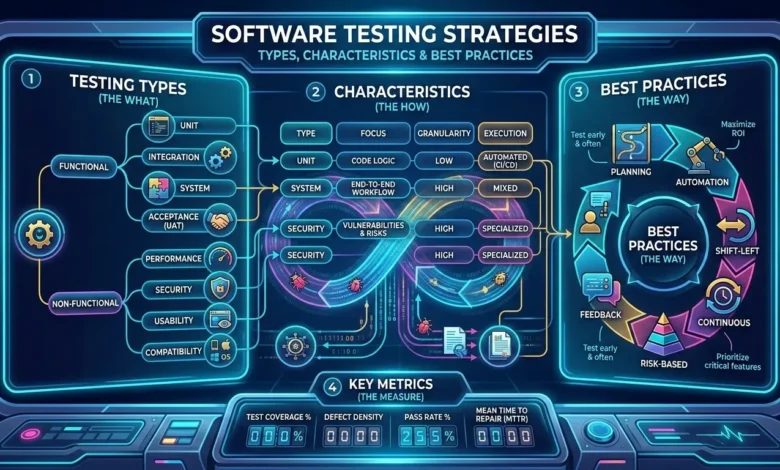
Software testing strategies are essential for building high-quality software. Every developer and QA professional needs to understand how to test software effectively. In 2026, software systems are more complex than ever. Applications rely on AI, cloud services, and distributed systems. Without proper testing strategies, software can fail in production, causing delays and financial loss.
Software testing strategies guide how testing is planned, executed, and measured. They ensure software meets requirements, performs reliably, and remains secure. Companies now demand engineers who can not only write code but also implement effective testing strategies. Knowing the different types, characteristics, and approaches to testing gives engineers an edge in the competitive market.
Table of contents
- What Are Software Testing Strategies
- Characteristics of Software Testing Strategies
- Types of Software Testing Strategies
- Conventional Software Testing Strategies
- Software Testing Strategies Diagram
- Why Software Testing Strategies Matter in Software Engineering
- How to Implement Software Testing Strategies
- Modern Trends in Software Testing Strategies for 2026
- Legal Access and Reading Resources
- Conclusion
- FAQs
What Are Software Testing Strategies
Software testing strategies are structured approaches to verifying software functionality. They define how to check whether the system works as expected and meets business requirements. I have seen many teams fail because they skip a structured approach. Without a clear strategy, testing becomes random, inconsistent, and ineffective.
A proper testing strategy considers the software lifecycle, risk areas, and user expectations. It outlines which tests to perform, when to perform them, and how to record results. In modern development environments, testing strategies must integrate with agile workflows, CI/CD pipelines, and automated testing frameworks.
Characteristics of Software Testing Strategies
Effective strategies share key characteristics. First, they are systematic. Each step has a purpose, from unit tests to system-level verification. Second, they are repeatable. Tests should produce consistent results across environments and versions.
Third, they are risk-focused. High-risk modules receive more attention to prevent critical failures. Fourth, strategies are measurable. Clear metrics help teams evaluate coverage, defect density, and quality trends. Finally, good strategies are adaptable. As software evolves, the testing approach must change to accommodate new features, platforms, or integrations.
Types of Software Testing Strategies
Software testing strategies fall into several types. Each serves a specific purpose and addresses different risk levels.
Unit Testing checks individual components or functions. It verifies that each small piece of code works correctly. Integration Testing ensures that multiple components interact correctly. This prevents failures when modules communicate. System Testing evaluates the complete system against requirements. It checks functionality, performance, and security at the application level.
Acceptance Testing confirms the software meets business and user requirements. Often, stakeholders or QA teams perform it. Regression Testing ensures new changes do not break existing functionality. Automated regression tests are common in modern CI/CD environments.
Other strategies include load testing, stress testing, and security testing. Load testing measures how the system behaves under normal and peak traffic. Stress testing pushes the system beyond limits to find breaking points. Security testing identifies vulnerabilities that hackers could exploit.
Each type of strategy complements others. A mature QA process integrates multiple strategies to achieve comprehensive coverage.
Conventional Software Testing Strategies
Conventional focus on manual testing and structured planning. They often follow the waterfall model, where testing occurs after development. Teams create test plans, write test cases, and execute them in sequence.
While modern agile and automated methods are more common today, conventional strategies still matter. They provide a solid foundation for understanding risk and coverage. Many teams combine conventional strategies with automated and exploratory testing to improve efficiency.
Software Testing Strategies Diagram
A diagram visually explains testing layers. Imagine a pyramid: the base represents unit testing, which covers most code with automated checks. The middle layer includes integration and system testing. The top layer includes acceptance and exploratory testing, which verify end-user experience and functionality.
Visualizing strategies in a diagram helps teams understand priorities. It clarifies which tests are critical, which can be automated, and where manual testing adds value. Diagrams also support communication between developers, testers, and managers.
Why Software Testing Strategies Matter in Software Engineering
They are vital in software engineering. They reduce defects, save time, and increase user satisfaction. Teams with clear strategies can release features faster and with confidence.
In large-scale projects, unstructured testing can cause cascading errors. One missed bug can affect multiple modules, leading to costly rework. Strong strategies prevent this by focusing on high-risk areas and maintaining test coverage throughout the development lifecycle.
Testing strategies also support compliance and security. In industries like finance, healthcare, and defense, companies must follow regulatory standards. A defined testing strategy demonstrates diligence and protects against legal and operational risks.
How to Implement Software Testing Strategies
To implement effective strategies, start with requirement analysis. Understand the system’s purpose, expected behavior, and critical components. Next, choose appropriate testing types for each module.
Automate repetitive tests whenever possible. Unit tests, regression tests, and load tests benefit from automation. Manual testing is best for exploratory testing, UI verification, and subjective assessments.
Document results carefully. Track defects, their severity, and resolution. Continuous improvement ensures that strategies evolve with software changes. Regularly review and update the strategy to keep it effective.
Modern Trends in Software Testing Strategies for 2026
In 2026, software testing strategies are influenced by AI and automation. AI-assisted testing predicts potential defects based on historical data. Test generation tools can create scenarios automatically.
Cloud-based testing platforms allow teams to run tests across multiple environments simultaneously. Continuous testing in CI/CD pipelines has become standard. Teams integrate testing early in the development cycle, shifting left to prevent bugs rather than just detecting them.
Remote collaboration tools have also changed how strategies are applied. Distributed teams can coordinate testing, share results instantly, and maintain consistency across locations.
Also Read: Software Engineer Jobs in 2026 – Remote, Entry Level
Legal Access and Reading Resources
Many engineers search for software testing strategies PDF or ebook versions. It is important to access content legally. Matthew Heusser’s Software Testing Strategies book provides deep insights into practical approaches. You can purchase it or access official ebook formats through authorized platforms.
Avoid unofficial free downloads. They may be outdated, incomplete, or illegal. Legal sources ensure you get accurate diagrams, examples, and explanations aligned with modern software engineering practices.
Reading the book online is possible through subscription services or libraries. It supports continuous learning and professional growth.
Conclusion
Software testing strategies remain a cornerstone of software engineering in 2026. They guide engineers in planning, executing, and measuring testing effectively. Understanding types, characteristics, and conventional approaches allows teams to reduce defects, increase reliability, and maintain high-quality software.
Modern strategies now integrate AI, cloud testing, and automation to adapt to complex systems. Legal access to books like Matthew Heusser’s ensures engineers learn best practices safely and effectively.
Whether you are a new grad, junior tester, or senior software engineer, mastering testing strategies is critical for career growth and project success. Following structured strategies ensures software performs reliably, meets user needs, and remains secure in today’s fast-changing tech landscape.
FAQs
What are software testing strategies in simple words?
The structured plans used to check whether software works correctly. They define what to test, how to test it, and when to test it. A clear strategy helps teams reduce errors and improve software quality before release.
Why this is important in software engineering?
It is important because they prevent defects from reaching users. They improve reliability, performance, and security. In software engineering, a strong testing strategy saves time, reduces costs, and protects company reputation.
What are the main types of software testing strategies?
The main types include unit testing, integration testing, system testing, acceptance testing, regression testing, load testing, and security testing. Each type focuses on a different part of the system to ensure complete coverage.
What are characteristics of effective software testing strategies?
Effective systematic, repeatable, measurable, risk-focused, and adaptable. They follow a clear structure and evolve as the software grows or changes.
What is a software testing strategies diagram?
A diagram visually represents different testing levels. Many teams use a testing pyramid model. The base shows unit testing, the middle shows integration testing, and the top shows system and acceptance testing. This diagram helps teams understand testing priorities.