
I spent years watching software projects fail the same way. Teams locked themselves into fixed plans. Requirements changed. The plan did not. Budgets blew. Deadlines slipped. Products launched that nobody wanted. Then I found adaptive software development. It solved the exact problem those teams kept hitting.
So what is adaptive software development? It is a software development methodology that treats change as normal not as a problem to manage. Teams plan in short cycles, collaborate constantly, and learn from each iteration. They adjust their approach based on real feedback instead of sticking to a plan that stopped making sense weeks ago.
Quick Summary Adaptive software development (ASD) is an agile methodology created by Jim Highsmith and Sam Bayer in the early 1990s. It replaces rigid, plan-driven development with a repeating three-phase cycle Speculate, Collaborate, Learn. Teams embrace uncertainty, work in short iterations, and continuously refine their product based on feedback. ASD works best for complex projects where requirements evolve. It grew out of Rapid Application Development (RAD) and directly influenced the Agile Manifesto in 2001. Today it remains highly relevant for teams building in fast-moving, unpredictable environments.
Table of contents
- What Is Adaptive Software Development in Simple Terms
- Where Adaptive Software Development Came From
- The Three Phases of Adaptive Software Development
- Key Characteristics of Adaptive Software Development
- Continuous Learning
- Decentralised Decision-Making
- Adaptive Software Development vs Other Methodologies
- Benefits of Adaptive Software Development
- Challenges of Adaptive Software Development
- Real Examples of Adaptive Software Development Working
- When to Use Adaptive Software Development
- How to Implement Adaptive Software Development
- Where Adaptive Software Development Is Heading
- Conclusion
- FAQs
What Is Adaptive Software Development in Simple Terms
Adaptive software development is built on one core belief. Change is not the enemy failing to respond to change is.
Traditional development methodologies treat change as a failure of planning. If requirements shift mid-project, something went wrong. The team scrambles to contain it. ASD flips this completely. It expects requirements to change. It builds that expectation directly into how the team works.
I think of ASD like a ship adjusting its course in real time. The destination stays the same. But the route changes based on wind, weather, and new information. A team using adaptive software development does exactly this. They know where they want to end up. They adjust how they get there based on what they learn along the way.
Where Adaptive Software Development Came From
Jim Highsmith and Sam Bayer created ASD in the early 1990s. They worked extensively with Rapid Application Development RAD and noticed its limitations. RAD moved faster than waterfall but still struggled when requirements changed significantly mid-project.
Highsmith and Bayer ran over 100 real-world commercial software projects using their new approach. They tested it across multiple industries. They refined it based on what actually worked. In 2000, Highsmith published the book Adaptive Software Development, which formalised the methodology for the broader software community.
In 2001, Highsmith became one of the 17 co-authors of the Agile Manifesto. ASD directly shaped the values and principles that the entire agile movement now runs on. If you use Scrum, Kanban, or any agile framework today, you benefit from the thinking that ASD introduced.
The Three Phases of Adaptive Software Development
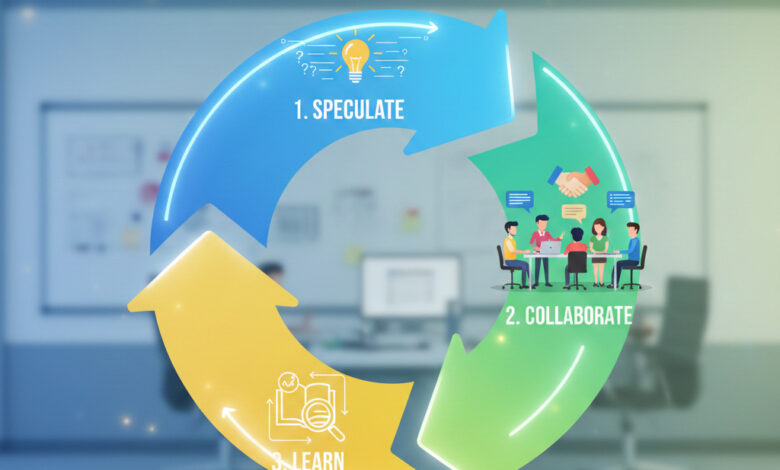
ASD runs on a repeating three-phase cycle. These phases are not sequential steps you complete one after another. They overlap. They inform each other constantly. Understanding this is critical to understanding how ASD actually works in practice.
Speculate
Teams start here. But “speculate” deliberately replaces the word “plan” and that choice matters.
Planning implies certainty. Speculation acknowledges uncertainty honestly. Teams define high-level project goals, identify initial requirements, and map out a rough release cycle. They do this knowing the details will change.
I found this phase liberating once I understood its intent. You stop pretending you know everything upfront and make your best informed guess. Commit to it short-term hold it loosely long-term.
The output of speculation is a flexible project mission broad enough to accommodate change, specific enough to give the team direction.
Collaborate
This is where the real work happens. Teams build the software iteratively in short cycles. Developers, designers, testers, and stakeholders work closely together throughout each cycle.
Collaboration in ASD goes deeper than just daily standups. It requires genuine trust. Team members must feel safe criticising each other’s work without it becoming personal. They must ask for help without feeling judged. They must share problems early rather than hiding them until they become crises.
I noticed the teams that struggle most with ASD fail here first. They treat collaboration as a process step rather than a culture. ASD requires the culture. The process alone does not work without it.
Learn
At the end of each cycle, teams stop and reflect. They examine what they built and gather feedback from users and stakeholders. They assess what they learned about the technology, the requirements, and their own process.
This phase feeds directly back into the next Speculate phase. What you learn changes what you plan next. The cycle restarts but the team is smarter, better informed, and more aligned than before.
The learning phase uses three specific mechanisms. Focus groups gather structured feedback from users. Technical reviews examine the quality of what was built. Project postmortems assess what worked and what did not in the process itself.
Key Characteristics of Adaptive Software Development
I want to explain each characteristic in practical terms not as a list of abstract values.
Adaptability Over Rigid Planning
ASD uses high-level planning rather than detailed fixed plans. Teams define goals and timeframes at the start. They do not lock in every task and dependency for the next six months. This keeps the team responsive when requirements shift which they always do.
Iterative Development
Work happens in short cycles. Each cycle delivers something functional. Teams do not build for months before anyone sees a working product. Users see progress early. Feedback comes in while there is still time to act on it.
Continuous Learning
Every cycle produces learning. Teams capture it deliberately. They use that learning to improve both the product and their process. Teams that skip the learning phase plateau quickly they repeat the same mistakes across cycles without understanding why.
Decentralised Decision-Making
Decisions happen at the team level. ASD does not rely on a project manager making every call from the top down. The people closest to the work make decisions about the work. This speeds up response time and improves decision quality.
Continuous Testing
Testing is not a phase at the end of development. Testing runs throughout every cycle. Teams catch problems while they are small and cheap to fix. They do not discover broken systems three months after the code was written.
Customer and User Focus
ASD keeps the end user visible throughout the entire process. User feedback drives iteration. Teams build what users actually need not what they assumed users needed six months earlier.
Risk Management Built In
Teams identify risks early and revisit them often. As the project evolves, risk profiles change. ASD builds in regular risk review as part of the learning phase rather than treating it as a separate activity.
Adaptive Software Development vs Other Methodologies
I want to make this comparison genuinely useful not just a table of checkboxes.
| Aspect | ASD | Waterfall | Scrum | Kanban |
| Planning approach | High-level, adaptive | Detailed, fixed | Sprint-based, iterative | Continuous flow, no fixed iterations |
| Response to change | Embraces it | Resists it | Accommodates it | Responds in real time |
| Phases | Speculate, Collaborate, Learn | Requirements, Design, Build, Test, Deploy | Sprint planning, execution, review, retrospective | Ongoing pull-based workflow |
| Customer involvement | High throughout | Low after requirements | High at sprint boundaries | Variable |
| Testing approach | Continuous throughout | End of project | End of each sprint | Continuous |
| Documentation | Light | Heavy | Light | Minimal |
| Best for | Complex, uncertain projects | Stable, well-defined projects | Teams needing structured sprints | Teams managing continuous workflow |
| Risk of scope creep | Moderate | Low | Moderate | Lower |
The most important comparison is ASD versus Waterfall. Waterfall assumes you can define everything upfront and the world will cooperate. ASD assumes the world will not cooperate and builds its entire process around that reality.
ASD sits closer to Scrum than to Waterfall. The main difference is that ASD’s three phases overlap and flow more fluidly than Scrum’s structured sprint boundaries. ASD gives teams more freedom in how they structure their cycles. Scrum gives teams more structure in how they organise their work within those cycles.
Also Read: Software NOOBS: Guide to Raspberry Pi’s Original OS Installer
Benefits of Adaptive Software Development
Faster delivery of working software. Short cycles mean users see functional software quickly. Feedback comes in while the team can still act on it meaningfully.
Higher product quality. Continuous testing catches defects early. Users validate requirements in real time. Teams build what users actually need rather than what was specified months ago.
Better risk management. Teams identify and address risks early in each cycle. Problems surface when they are small rather than when they are catastrophic.
Stronger team ownership. Decentralised decision-making gives teams genuine ownership of their work. Teams that own their decisions work harder to make them succeed.
Increased customer satisfaction. Regular user involvement means the product evolves to match real needs. Customers see their feedback reflected in the product. Trust between teams and customers strengthens over time.
Genuine transparency. Stakeholders see real progress at the end of each cycle. There are no surprises at launch. Everyone stays informed throughout the process.
Challenges of Adaptive Software Development
I want to be honest about the difficulties every article that skips this section is selling you something.
Requires deep user involvement. ASD needs active, ongoing participation from users and stakeholders. If users cannot commit time regularly, the feedback loop breaks. Cycles complete but learning does not happen. The product drifts away from real needs.
Collaboration is genuinely hard to build. ASD demands a specific team culture one built on trust, psychological safety, and honest communication. You cannot install that culture overnight. Teams that lack it will struggle with ASD regardless of how well they understand the methodology.
Scope creep is a real risk. Welcoming change sounds good in principle. In practice, it requires discipline to distinguish valuable adaptation from endless feature addition. Teams without strong product ownership often find their scope expanding continuously with no clear end in sight.
Higher ongoing cost. Continuous testing throughout every cycle costs more than testing at the end of a project. Extensive user involvement requires time from people who have other responsibilities. These costs are worth it for the right projects but they are real costs that must be budgeted honestly.
Documentation is often neglected. ASD’s preference for lightweight documentation can leave knowledge gaps. When team members change, the lack of documentation creates problems. Teams need to find the right balance enough documentation to preserve knowledge, not so much that it slows iteration.
Real Examples of Adaptive Software Development Working
An Enterprise Team That Fixed Its Release Problem
I worked with an enterprise software team that released major updates twice a year. Each release took months to stabilise after launch because requirements had drifted so far from reality during development. They introduced ASD-style iterative cycles four weeks each, with user testing at the end of every cycle. Within three cycles they started catching requirement drift within weeks rather than discovering it at launch. Their post-release stabilisation period dropped from two months to two weeks. The cost of that change was greater user involvement throughout development a cost every stakeholder agreed was worth it.
An Education Platform That Improved Retention Dramatically
I researched an education technology company that built a learning platform for corporate training. They used adaptive software development from the start. Each four-week cycle ended with structured feedback sessions from real users corporate trainers and their students. After cycle two, users told them the navigation was confusing. The team redesigned it in cycle three. After cycle five, users said the content format was not working for mobile learners. The team adapted. By launch, the platform reflected six cycles of real user input. User retention in the first month after launch was significantly higher than industry benchmarks. The team attributed it directly to the ongoing user involvement that ASD required.
When to Use Adaptive Software Development
ASD works best in specific conditions. Knowing when to use it is as important as knowing how.
Use ASD when: Requirements are likely to change significantly during development. The project involves high complexity or uncertainty. Users can commit to regular involvement throughout development. The team has the cultural foundation for genuine collaboration. The organisation values learning and continuous improvement over predictability.
Avoid ASD when: Requirements are stable and well-defined from the start. The project operates under strict regulatory compliance that demands fixed documentation and processes. The team is geographically distributed in ways that make real-time collaboration genuinely difficult. Users or stakeholders cannot commit meaningful time during development. The organisation has a strong preference for predictability over flexibility.
How to Implement Adaptive Software Development
I want to give you a practical starting sequence not a theoretical framework.
Define your mission, not your specification. Write a clear statement of what the project aims to achieve for users. Keep it broad enough to accommodate change. This is your north star across all cycles.
Set your cycle length and stick to it. Most ASD teams work in two-to-four-week cycles. Choose a length and do not extend individual cycles when things get difficult. Discipline around cycle boundaries forces the team to make decisions and deliver rather than endlessly refining.
Identify your core collaboration group. Decide who participates in each cycle. Include developers, designers, testers, and at least one product owner. Identify your user representatives real users who will review each cycle’s output and provide feedback.
Run your first Speculate phase honestly. Define high-level requirements and release targets. Acknowledge what you do not know. Identify your highest risks upfront. Resist the urge to over-specify leave room for the learning process to inform future cycles.
Build your learning rituals before you need them. Set up your focus groups, technical reviews, and postmortem format before your first cycle ends. Teams that try to establish these practices under end-of-cycle pressure usually skip them. Build the habit structure first.
Review and adapt after every cycle without exception. The learning phase is not optional. Teams that treat it as optional stop learning and start repeating mistakes. Make the review a non-negotiable end-of-cycle commitment from the start.
Where Adaptive Software Development Is Heading
ASD has never been more relevant than it is today. Three trends are driving this.
Software complexity keeps increasing. Products integrate AI, real-time data, third-party services, and multiple platforms simultaneously. No team can define all requirements for that level of complexity upfront. ASD’s iterative, learning-oriented approach handles complexity better than any plan-driven methodology can.
Markets move faster than ever. The time between identifying a user need and needing a working solution is shrinking. Teams that plan in six-month blocks cannot compete with teams that deliver and learn in two-week cycles. ASD’s short cycle structure aligns with the speed that modern markets demand.
AI-assisted development is changing how teams work. AI tools handle more routine coding tasks. Teams focus more on understanding user needs, making design decisions, and learning from feedback. These are exactly the human activities that ASD was built around. As AI handles more implementation, the collaborative and learning-oriented aspects of ASD become more not less central to how good software gets built.
Conclusion
What is adaptive software development? It is the honest answer to how software actually gets built well in the real world. Requirements change. Markets shift. Users know what they want only after they see what they do not want. ASD builds all of that reality into the development process from day one. It replaces false certainty with structured adaptability and rigid plans with continuous learning. It replaces end-of-project surprises with ongoing collaboration. For teams building complex software in fast-moving environments, ASD is not just a methodology it is a fundamental shift in how you think about what good development looks like.
FAQs
What is adaptive software development in simple terms?
Adaptive software development is a way of building software that treats change as normal rather than as a problem. Teams work in short cycles, deliver working software regularly, gather feedback from real users, and adjust their approach based on what they learn.
Who created adaptive software development and when?
Jim Highsmith and Sam Bayer created adaptive software development in the early 1990s. They developed it as an evolution of Rapid Application Development, designed to handle complex projects where requirements changed significantly during development.
How is adaptive software development different from Scrum?
Both ASD and Scrum are agile methodologies that work in iterative cycles and emphasise continuous learning and customer involvement.
What are the main benefits of adaptive software development?
The main benefits are faster delivery of working software, higher product quality through continuous testing, better risk management through early and regular risk review, stronger team ownership through decentralised decision-making.
When should you not use adaptive software development?
Avoid ASD when requirements are stable and well-defined from the start waterfall or other plan-driven approaches work better in those conditions.